There's a particular kind of tired that comes with managing: the day is wall-to-wall, everyone seems to need you, and your own work starts at six in the evening when the pings stop. Ask a swamped manager what's wrong and you'll usually hear some version of "everything routes through me." That sentence feels like a complaint about workload. It's actually a diagnosis — and the treatment is not working harder.
The shift nobody spells out at promotion time: your output is now your team's output. As an individual contributor, working more hours produced more work. As a manager, your hours are no longer the constraint that matters — the constraint is how much of the team's capacity is idling while things wait on you. Getting more done through your team is a system, and it runs on four levers: hand over real authority, prioritize honestly, cut the meeting tax, and protect focus. This guide is the map of that system; each lever has its own deep-dive on this site.
The bottleneck math
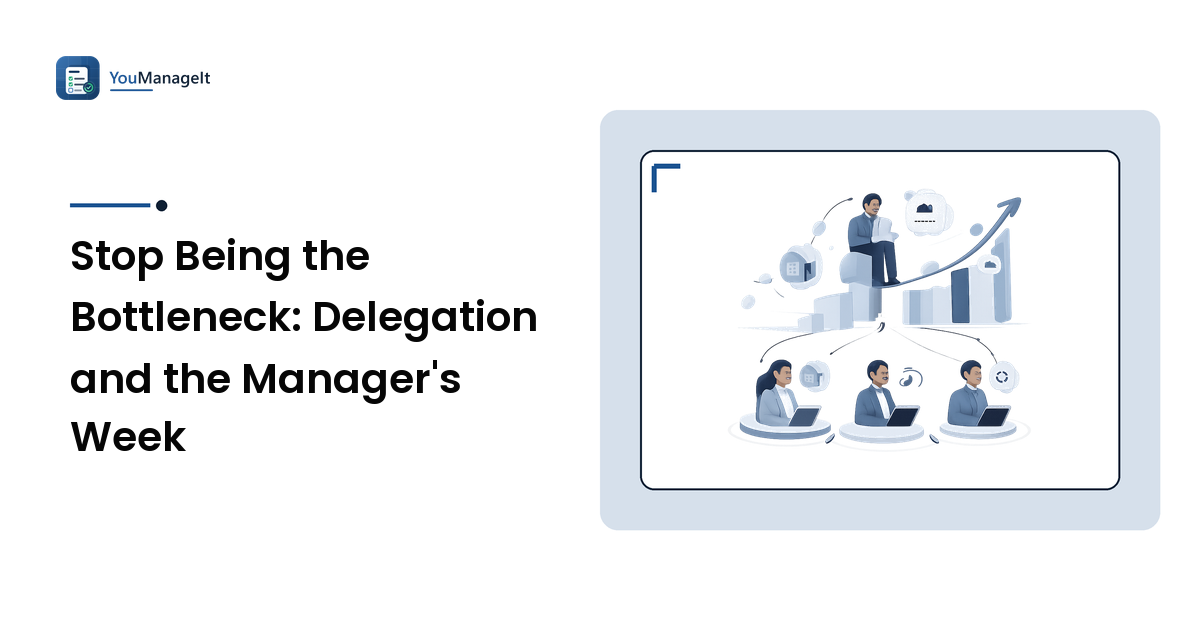
Picture your team's work as a set of pipes and yourself as the junction every pipe passes through. Every decision that needs your sign-off, every task only you know how to do, every question only you can answer — each one is work queuing at the junction. When you're at capacity, the queue grows, and here's the part that stings: the team isn't overworked while this happens. They're waiting. Blocked on approvals, blocked on answers, redoing things because the guidance came late.
That's why "I'll just put in more hours" fails as a strategy. Extra hours widen the junction a little; they do nothing about the design flaw of everything passing through it. The four levers below all attack the same problem from different sides: fewer things routing through you, and better throughput on the things that genuinely must.
Lever 1: Delegate the outcome, and say how much rope comes with it
Most managers think they delegate. What many actually do is assign tasks while keeping every decision — which means each task comes back with questions, and the junction stays jammed.
Two moves change that. The first is delegating outcomes rather than steps: "you own the weekly client report" creates someone who can absorb questions, decisions, and follow-ups that used to be yours; "format this table by Friday" creates another item you have to inspect. The second — the one that stops delegated work bouncing back to your desk — is naming, out loud, how much authority travels with the work: research it and bring me options, recommend one, decide but check first, or decide and go. People bring work back not because they're incapable but because they don't know how much rope they have. The full ladder, with scripts, is in delegating at the right level — if you read one spoke of this guide, read that one.
What should go first? The recurring things. A weekly task delegated once pays you back every week, and its repetition is exactly what makes it teachable. Accept the trade-off honestly: the first handover is slower than doing it yourself, and the first version will be about eighty percent of what you'd have produced. You are not trading quality for time — you're trading one slow week for every week after it.
And once it's handed over, resist checking on it hourly. Delegation dies under surveillance, because people who feel watched route every decision back to you — recreating the bottleneck with extra resentment. If you genuinely need visibility, build it into the work, not over the worker; tracking your team's time without micromanaging covers where that line sits.
Lever 2: Prioritize like the junction you are
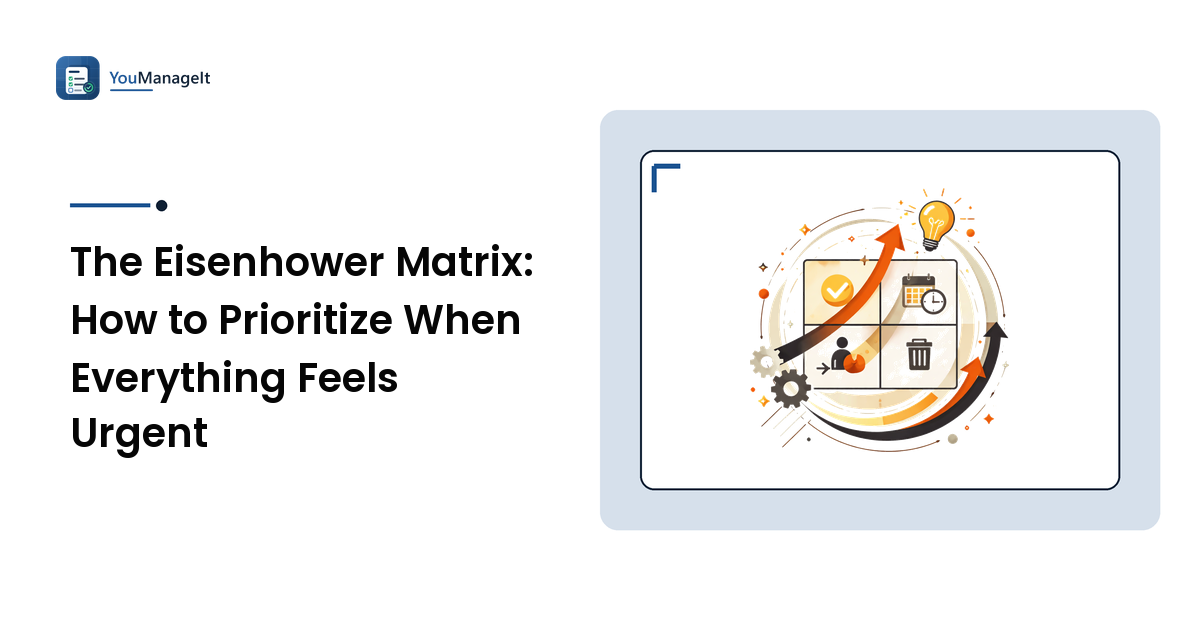
Delegation frees up hours; prioritization decides what they're spent on. The classic tool here is sorting by urgent versus important — the Eisenhower matrix — and it works, but managers need one extra question bolted on: not just "does this matter?" but "must it be me?"
Run the day's list through that filter and it splits four ways: things only you can do (do them), things someone else could do with a handover (lever 1), things that are urgent only because they're loud (schedule or shrink them), and things nobody should be doing at all (stop them — inherited reports and rituals survive for years past their usefulness because stopping them is nobody's job). Managers consistently over-populate the first pile. "Only I can do this" is true far less often than it feels; usually the honest version is "only I can do this today," which is an argument for a handover, not for keeping it.
Lever 3: Cut the meeting tax
Meetings are the visible half of a manager's overload, and the half most on the calendar's record. The tax isn't only your hours — a recurring meeting with six people spends six people's hours, and as the organizer you set that multiplier.
The durable fix is a default: a meeting must earn its slot, and anything that's really a status update, an FYI, or a document review goes asynchronous instead. Should this be a meeting? gives you the decision framework; applied honestly to your standing calendar, it usually finds at least one recurring slot that can shrink, merge, or die.
One exception worth defending: keep your one-on-ones. They look like the easiest cut precisely because they're not urgent — but they're where small problems get caught early, and cancelling them trades a quiet half-hour now for interruptions and rework later. Cut the broadcast meetings, not the individual ones.
Lever 4: Protect focus — yours and theirs
The hours the first three levers recover arrive as fragments, and fragmented time is where important work goes to die. Two disciplines turn fragments back into output.
Give the recovered time a job before the week starts, or the queue of small urgencies will absorb it silently — that's time blocking, and for a manager the crucial block is the one reserved for the work only you can do. Then defend the block's depth: switching between the block and the pings costs far more than the seconds each ping takes, because every switch reloads context. Why that cost is so much higher than it feels — and what to do about the ping traffic itself — is covered in context switching, and the practice of working in genuinely uninterrupted stretches in the deep work guide.
The manager's twist on all this: you are probably the biggest single source of your team's context switches. Every "quick question" you drop into someone's afternoon costs them the same reload it costs you. Batch your non-urgent asks — into the one-on-one, into a daily digest message — and you protect the team's focus with the same move that protects yours.
Where to start
Systems fail when installed all at once. This week, make three moves — one per day is fine:
- Hand over one recurring task, with the authority level said out loud.
- Kill or shrink one standing meeting, using the should-this-be-a-meeting test on your own calendar first.
- Block two hours for the thing only you can do, and treat the block like a meeting with your most important stakeholder.
Small, but compounding: the delegated task pays weekly, the dead meeting refunds everyone it invited, and the block is where your actual leverage gets built. The deeper foundation — the trust that makes people comfortable running with delegated authority — is the territory of the leading people guide; this system works best sitting on top of it.
FAQ
What should a manager delegate first?
A recurring task with a teachable pattern — a weekly report, a routine approval, a regular client touchpoint. Recurrence means the handover cost is paid once and the time comes back every week, and it gives the person repeated practice at the same thing instead of one high-stakes novelty.
Isn't it faster to just do it myself?
This week, yes. Every week after, no. "Faster myself" is true per-instance and false per-quarter — and it quietly caps your team's growth, because nobody develops judgment on work they never get to own. If a task will recur more than a handful of times, the handover pays for itself.
How do I delegate without it feeling like dumping?
Dumping is handing over a task with no authority, no context, and no interest in the outcome. Delegating is handing over an outcome with the authority level stated, the "why" attached, and a named check-in. The difference is almost entirely in whether the person can make decisions or only do labor.
What if my team is already at full capacity?
Then start with levers 2 and 3 — stop low-value work and cut meeting load — because those create capacity on the team's side before you route anything new to it. A surprising amount of "full capacity" is meetings, status theater, and inherited tasks nobody has re-examined.
How do I know it's working?
Watch the queue, not the hours: fewer decisions waiting on you, fewer tasks bouncing back after handover, and a calendar where the work only you can do has protected time. If people are making calls at the authority level you named — without checking first — the bottleneck is dissolving.
The multiplier, not the junction
A manager at capacity feels essential and is actually the constraint. Move the work to the people who can own it, keep only what must be yours, refund the meeting hours, and give the recovered time a job. For more plain-spoken guides to the day-to-day work of managing, visit You Manage It.