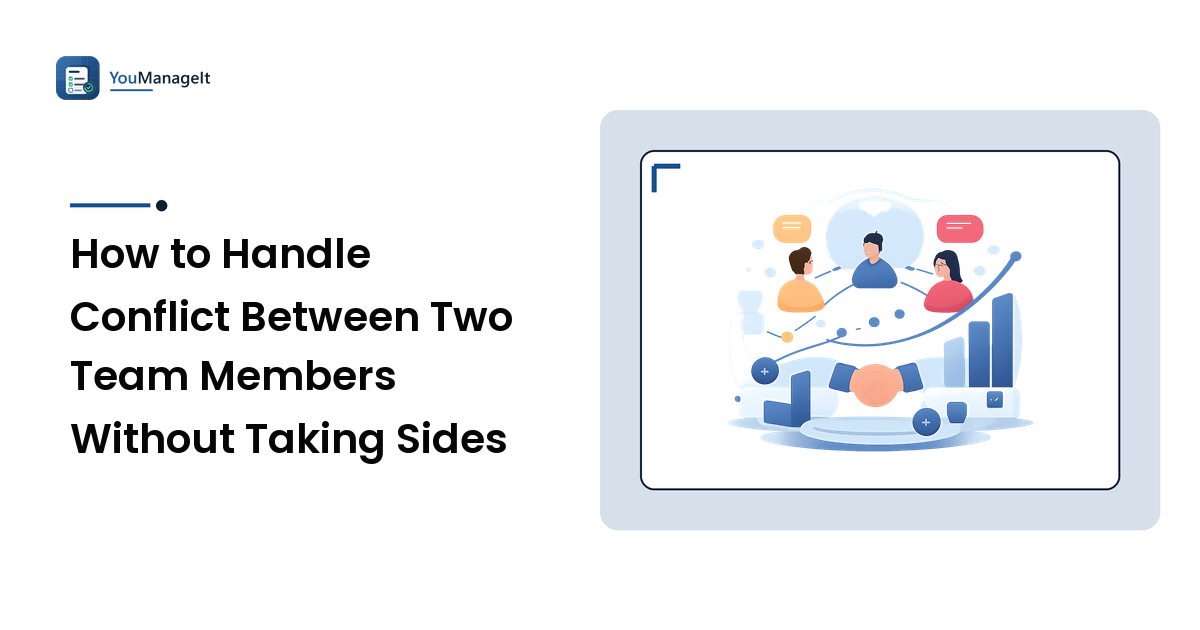
Two people on your team have stopped working together. Maybe it's cold and quiet — clipped replies, pointed silences, work handed off with a sigh. Maybe it's loud. Either way, everyone else can feel it, the work is slowing down, and both of them keep dropping hints that they want you to do something about it. And you're stuck, because whatever you do, it feels like you're about to pick a side.
The takeaway up front: your job in a team conflict is not to decide who's right — it's to get two adults working together again. That's a lower bar than justice and a much more useful one. You are not a judge handing down a verdict; you're a mediator helping two people find a way forward they can both live with. Once you stop trying to figure out who started it, the whole thing gets easier — and this guide walks through exactly how to do it.
First, decide whether to step in at all
Not every disagreement is a conflict you need to manage. Some friction is healthy — two people arguing hard about the right approach and then getting on with it is a sign of a team that cares, not a broken one. Stepping into that only teaches people they can't handle their own tensions.
So before you intervene, ask whether this has crossed a line. Step in when the conflict is affecting the work (missed handoffs, dropped balls, decisions stalling), spilling onto other people (the team walking on eggshells, others being pulled in to take sides), or turning personal rather than professional. If it's a one-off bad day or a spirited debate that resolved itself, let it be. If it's a pattern that's now shaping how the team operates, it's yours — and waiting for it to "sort itself out" almost never works. Left alone, these things harden: positions calcify, small slights become the whole story, and neutral colleagues get recruited into camps.
Get the real story — meet each person separately first
The instinct to grab both people and "hash it out" in one room is understandable and usually a mistake. Walk them in cold and you'll get a performance for the boss, two rehearsed complaints, and a lot of defensiveness — not the truth.
Meet each person one-on-one first. Keep it calm and genuinely curious, and make one thing clear at the start: you're not here to judge, you're here to understand and help fix it. Then listen more than you talk. A few questions do most of the work:
- "Tell me what's been happening from your side." Let them get it all out without interrupting. People can't think about a solution until they feel heard.
- "What do you actually need to do your job well?" This is the most important question you'll ask. It moves them off their position ("he never tells me anything") and toward their interest ("I need to know about changes before the client does"). Interests are where solutions live.
- "What do you think is going on for the other person?" This gently invites empathy and tells you how far apart they really are.
Your goal in these meetings isn't to gather evidence for a ruling. It's to find the real issue under the surface, which is almost never the thing they're arguing about. "She's so controlling" often means "I don't feel trusted." "He's impossible to work with" often means "our roles overlap and no one drew the line." Most team conflict is a structural or communication problem wearing a personality costume — and once you see the interest under the complaint, you usually see the fix.
Bring them together — and run the conversation
Once you understand both sides, bring them together. This is the part managers dread, so structure it tightly; a clear shape keeps it from sliding into a shouting match or a sulk.
Open by setting the frame. Say plainly what you're there to do and lay down two or three ground rules: one person talks at a time, no interrupting, and the topic is behavior and work, not character. State the shared goal out loud — "you both want this project to go well and neither of you wants to dread coming in" — so they start on the same side of something.
Then have each person describe the issue to each other, not to you. This is a subtle but powerful shift. If they're talking to you, they're competing for your approval; if they're talking to each other, they're rebuilding a relationship. Your job is to stay neutral and keep it safe: cut off personal attacks, and when someone makes a vague accusation, slow it down — "can you give a specific example?" turns "he's dismissive" into a concrete moment you can actually solve.
Reflect back what you hear, especially the underlying need. "So it sounds like you need more warning before things change, and you need fewer interruptions when you're heads-down — is that fair?" When people hear their real interest named neutrally, the temperature drops fast, because the fight was never really about winning; it was about not being heard. Staying calm and curious here is the same muscle you use in any hard conversation — the leading people guide goes deeper on holding your nerve when a discussion gets tense.
Land a concrete agreement, then follow up
A conversation that ends on "okay, we'll try to be better" has solved nothing. Feelings improve for a day and the same collision happens next week. The point of the meeting is a specific, behavioral agreement about what changes.
Push for the concrete. Not "communicate better" but "post project changes in the shared channel by end of day, so no one hears it secondhand." Not "be more respectful" but "if one of us is heads-down, ping on chat instead of stopping by." Where the root cause is structural — overlapping roles, an unclear handoff, a missing decision-owner — fix the structure, because no amount of goodwill survives a genuinely broken process. Sometimes the most useful thing you do in the whole meeting is draw a line neither of them had the authority to draw alone.
Write down what you all agreed, even informally, and set a date to check in. The follow-up matters more than people expect: it tells both of them you're serious, gives you a moment to catch backsliding early, and turns a one-off truce into a real reset. Your regular one-on-ones are the natural place to quietly take the temperature over the following weeks — is it actually better, or just quieter?
When mediation isn't enough
Most conflicts resolve at the level above — two reasonable people, once they feel heard and have a clear agreement, get back to work. But not all. Sometimes one person won't engage in good faith, keeps breaking the agreement, or the "conflict" is really one person behaving badly toward another. That's no longer a mediation; it's a performance or conduct issue, and you manage it as one — directly, with that individual, not as a shared problem to be negotiated. Splitting the difference when one person is genuinely in the wrong just punishes the reasonable one and tells your team that being difficult works.
Know your limits, too. If there's any hint of bullying, harassment, or discrimination, this stops being something you mediate on your own — loop in HR and follow your organisation's process. The strongest thing you can do there is not improvise.
FAQ
Should I let my team resolve conflicts themselves?
Usually, yes — for normal friction. Two colleagues who can talk out a disagreement without you are a healthy sign, and jumping in too fast teaches learned helplessness. Step in when the conflict is hurting the work, pulling in other people, or has turned personal and stuck. Your aim is to build a team that handles most tension itself and only escalates the genuinely knotty stuff.
How do I stay neutral when I think one person is right?
Separate the two jobs. Getting them working together again is the mediation; whether someone's behavior meets the bar is a performance matter you handle privately, later, one-on-one. In the joint conversation, staying neutral isn't pretending you have no view — it's refusing to litigate blame, because the moment you crown a winner, the other person stops listening and the relationship you're trying to repair breaks further.
What if the conflict is between me and a team member, not between two others?
Then you can't be the neutral mediator — you're a party to it. Own that. Have the conversation directly, lead with the shared goal, ask genuinely what they need, and be willing to hear that part of the problem is you. If it stays stuck, it's fair to bring in a neutral third party, such as your own manager or HR, to help you both talk it through.
How soon should I address conflict between two team members?
Sooner than feels comfortable, but not so fast you skip understanding it. Once it's clearly affecting the work or the wider team, don't let it sit — delay lets positions harden and drags others into camps. Give yourself enough time to meet each person separately and grasp the real issue, then bring them together. Days, not weeks.
What if they agree in the meeting but nothing changes afterward?
That's why the follow-up exists. Go back to the specific, behavioral agreement you wrote down and name what you're seeing plainly: "we agreed changes go in the shared channel, and that didn't happen twice this week." If one person keeps breaking a fair agreement they signed up to, you've moved out of mediation and into an accountability conversation with that individual.
Next step
Don't call the big meeting yet. Do the quiet work first: sit down with each person on their own, ask what they actually need to do their job well, and listen for the interest hiding under the complaint. That one step turns most conflicts from a standoff you have to referee into a problem you can help solve — and you'll walk into the joint conversation with the agreement already half-written. For more calm, practical guidance on the human side of leading a team, visit youmanageit.com.