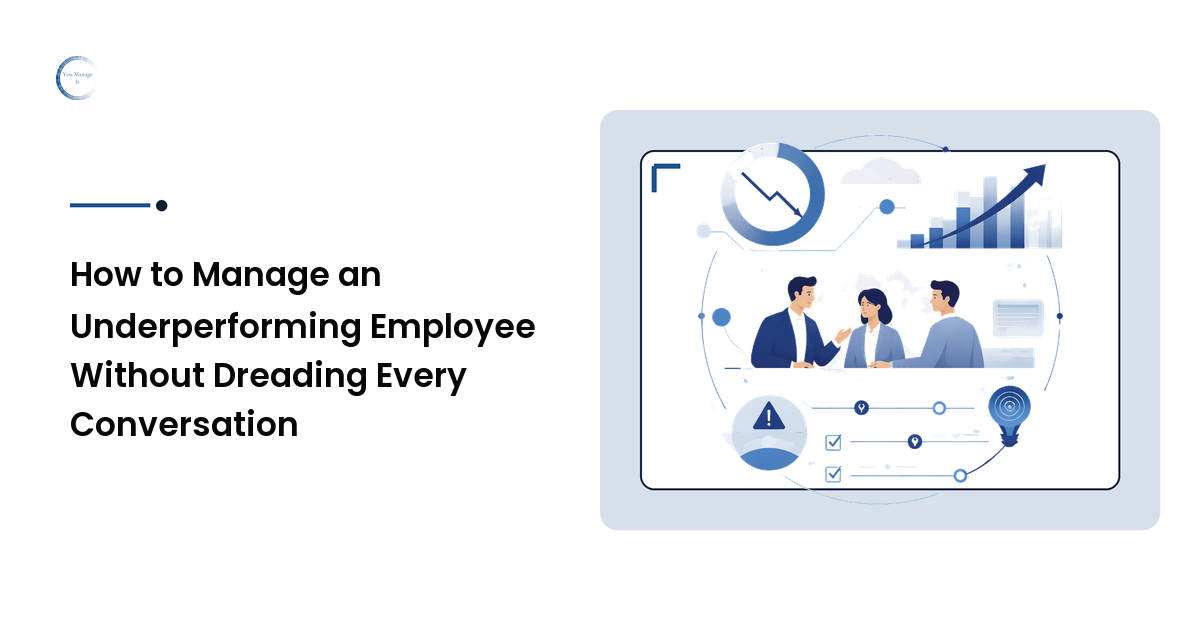
One person on your team keeps missing the mark. The work comes in late, or half-right, or needs redoing — and you've quietly started routing the important things to someone else. You know you should say something, and you've known for weeks. But the conversation feels so uncomfortable that you keep finding reasons to wait — and every day you wait, the problem hardens and the team notices.
The takeaway up front: managing an underperforming employee is not a single brave conversation — it's a short, fair process, and the hardest part is starting it early instead of late. Most managers wait too long, hoping it resolves itself, then arrive at the talk frustrated and vague. Done well, it's calmer than you think — you name the gap, find out why it exists, and give it a real chance to improve.
Start by getting specific about the gap
Before you talk to anyone, get honest about what "underperforming" actually means here. "They're just not great" is a feeling, not a problem you can manage — you need a gap you can point at. Write down two things side by side: what good looks like for this role, and what you're actually seeing. Be concrete. Not "their work is sloppy" but "the last three reports had errors I had to catch, and two missed the deadline." That separates a real performance gap from a personal annoyance — and sometimes reveals that the standard was never actually communicated, which makes part of the gap yours, not theirs.
Diagnose the cause before you judge the person
Knowing how to handle an underperformer starts with one rule: don't assume you already know why. Managers jump to "they don't care" or "they're not capable," when the real cause is usually more specific and more fixable. Sort it into one of these.
- They don't know what's expected. The standard lives in your head, unspoken, so they don't know they're not meeting expectations — yours to fix.
- They don't know they're falling short. No one told them clearly, so they think things are fine. Silence is not feedback.
- They lack a skill or tool. Trying, but missing training, access, or context. Usually fixable fast.
- Something outside work is interfering. Health, family, burnout. This needs support, not a performance plan.
- They're in the wrong role. Good person, poor fit for this job. Sometimes solvable by reshaping it; sometimes not.
- They genuinely aren't trying. Real, but rarer than frustrated managers assume — and the only case where the answer is mostly accountability, not support.
You can't tell which from your desk — that's what the conversation is for.
Have the conversation — calmly, and soon
A performance conversation is one of those difficult conversations at work that managers dread, mostly by imagining it as a confrontation. Reframe it as problem-solving between two adults and it gets far easier. Hold it privately — never in passing or in front of others.
A simple structure that keeps it fair and non-explosive:
- Name the gap plainly, with facts. "I want to talk about the last few reports — three had errors I had to fix, and two came in late." No long wind-up, no sandwiching it between fake praise; that only muddies the message.
- Then stop talking and listen. The part managers skip. Ask "what's making this hard?" and actually wait. This is where you learn which cause you're dealing with, which decides what you do next.
- Be clear it matters. Kindly, without threats: "This part of the role is important, and it's not where it needs to be." People can handle directness; what corrodes trust is vagueness, then a surprise.
- Agree what changes and by when. Specific actions, owned by specific people — including you, if part of the fix is clearer instructions or training. End with a concrete check-in point.
Stay curious rather than annoyed — you're not delivering a verdict, you're opening a process. For a deeper toolkit — scripts and how to weave feedback in regularly so it never builds into one scary talk — see the one-on-ones and feedback guide.
Make a plan, then give it a fair shot
A conversation without a plan is just a complaint. For most cases the plan is informal: a few clear actions, a shared understanding of the standard, and a date to review — so you both know what "back on track" means and when you'll check.
If the issues are serious or persistent, you may move to a formal performance improvement plan (PIP) — a documented set of expectations, support, and a timeframe. Used honestly, it's a genuine chance to improve with help. Used as paperwork before a firing, people see straight through it and it poisons their trust. Give the support you promised, and follow your organisation's HR process — PIPs carry legal and policy implications you shouldn't improvise.
Then give it time. Improvement is rarely instant, and pulling the plug at one more slip tells the team that effort doesn't count. Check in at the points you agreed, notice progress out loud, and adjust.
Know when it's not working — and act fairly
Sometimes you do everything right and the gap stays. The expectations were clear, the support was real, the time was fair — and the performance didn't move. At that point, waiting isn't kindness; it's avoidance, and it's unfair to everyone else carrying the load.
Two honest outcomes remain. Sometimes it's a role-fit problem, and the right move is reshaping the job or helping the person find one that suits their strengths. Sometimes it ends in letting them go. Neither is fun, but dragging it out helps no one — least of all the person stuck failing in the wrong job. When you reach this point, slow down and involve HR: documentation, process, and the conversation itself all matter, for fairness and legal protection. The managers who handle this well aren't the ones who enjoy it — they're the ones who started early and stayed fair.
FAQ
How long should I give an underperforming employee to improve?
Long enough to be fair, which depends on the role and the gap — a few weeks for a simple skills or clarity issue, longer for something complex. Agree the timeframe up front so neither of you is guessing. What matters more than the exact length is that you set clear checkpoints and honour them, instead of quietly extending forever or pulling the plug early.
What if the underperformance is caused by a personal problem at home?
Then it's a support situation, not a performance case, and you treat it differently. Lead with empathy, ask what would help, and flex what you can — deadlines, workload, time off — within what your HR policies allow. Keep the standard honest, but give the person room while they work through it.
Should I put the employee on a performance improvement plan right away?
Usually not as a first move. Start with a clear conversation and an informal plan; reserve a formal PIP for issues that are serious or didn't improve after you raised them. When you use one, treat it as a real chance to improve and follow your organisation's HR process closely.
How do I manage an underperformer without the rest of the team noticing?
You can't fully hide it, and trying to is the wrong goal. Keep the specifics private, but accept that your team already sees who's carrying weight and who isn't. What protects trust isn't secrecy — it's being seen to address problems fairly, so good performers know their effort is noticed and slipping isn't quietly tolerated.
What if the underperformance is partly my fault?
Own it — that's a sign you're diagnosing honestly. If the expectation was never clear, the training was missing, or you never gave real feedback, part of the fix is yours. Saying so ("I don't think I made this standard clear enough — let's reset it together") doesn't weaken your authority; it builds trust and makes the person far more willing to meet the bar you now set.
Next step
Stop rehearsing the talk and do the one thing that unblocks it: write down what "good" looks like for this role, set it beside what you're seeing, and name the real gap. Then book the conversation — privately, soon — and go in to listen as much as to tell. For more practical, do-it-this-week management guidance, visit youmanageit.com.